Sample article.Written from your “How I Use AI in My SEO Work” document. The featured image and diagram are illustrations; the screenshots are real Ahrefs data from 6 Nov 2026. Review it, then keep or replace it.
AI can take most of the slow work out of SEO: reading search results, sorting keywords, drafting briefs and pulling reports together. It can’t decide what your customers need, check that your facts are true, or take responsibility for what goes live.
So I split the work. AI handles volume and speed. I make the calls on strategy, facts, brand voice and publishing.
Here is how that works across a full month, and what it produced on a live store.
The monthly loop
Each month the work moves through eight steps: discover, audit, prioritise, plan, create, optimise, measure and refine. How much time each step gets depends on the site and the challenges it faces. AI is involved in all eight. Three of them wait for a person to approve before the work moves on.
- The pages to build. Keyword research produces a shortlist, and the client approves it before anything is written.
- Every draft. Nothing is published until a draft has been reviewed.
- Theme changes. Technical fixes are made on a preview copy, and a person publishes them.
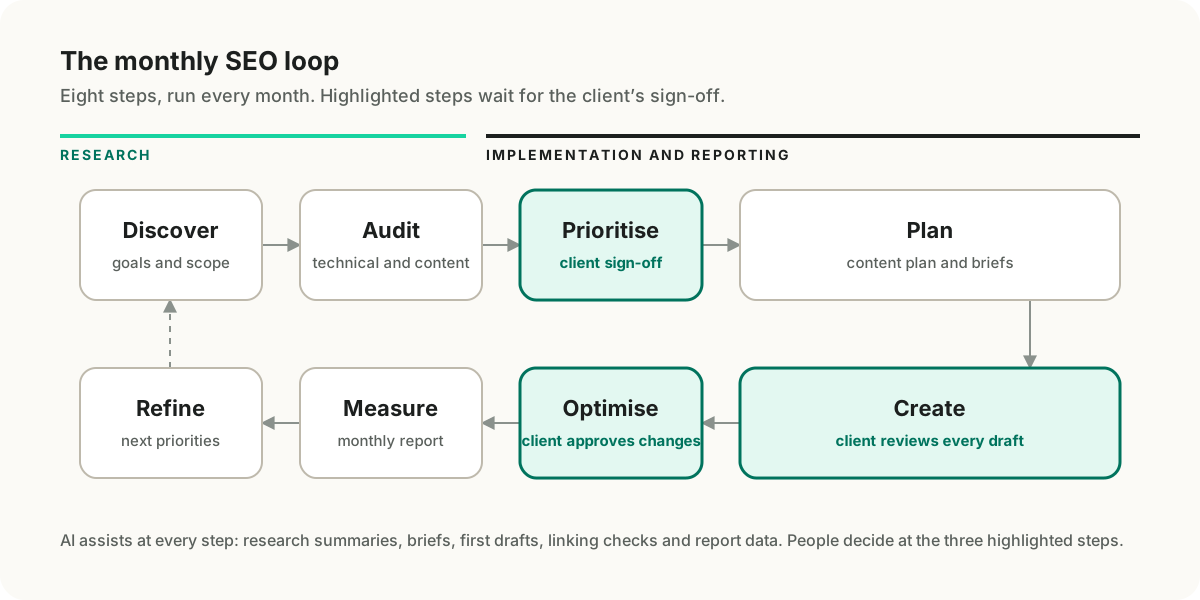
Those gates are where mistakes would be expensive. Everything else can move quickly.
Where AI saves the most time
Keyword research
I name one topic cluster. AI checks the live search results first: who ranks, which page types win, what People Also Ask shows and whether there’s an AI Overview. Then it pulls matching and related terms from Ahrefs and Google Keyword Planner.
For newer sites, only keywords with an Ahrefs Keyword Difficulty under 20 survive. Each page gets one primary keyword, so new pages don’t compete with each other.
Content briefs
Each brief holds the meta title, a review of the top 10 results, the entities to cover, a heading outline and the internal links to include. AI assembles it in minutes. I add my own notes at the end, and the draft follows them.
Drafts and graphics
Claude and ChatGPT write first drafts to each brand’s guidelines: an answer-first opening, the right spelling, FAQs where they help, and three to seven internal links to live pages. Higgsfield helps turn the client’s own photos into article graphics.
Reporting
Each month the same views come out of Search Console, Google Analytics and Ahrefs, compared with a fixed baseline. Exact figures come from the data, not from reading charts by eye.
Where a person has to decide
AI is good at patterns. It is not accountable for outcomes. These decisions stay with me:
- Search intent: whether a page will earn sales or enquiries, or just empty traffic.
- Facts: prices, specs, safety and sourcing claims must be true.
- Brand voice: the tone and terms a business is known for.
- Publishing: what goes live, and when.
The guardrails that keep quality high
Most AI content problems come from a missing check, not a bad tool. These rules catch them early.
Unverified facts become placeholders. Anything AI can’t confirm, such as a cook time, a supplier spec or a certificate, becomes a visible [TO CONFIRM] note. Nothing goes live with one left in.
- Theme changes go to a preview copy first, so the live site never breaks mid-edit.
- Every change is re-read after it lands, so errors are caught in minutes.
- Content plan rows are added or updated, never overwritten.
- When something goes wrong, the fix becomes a written rule so it doesn’t happen twice.
What this produced on a live store
On an Australian online meat retailer, this workflow produced 163 live pieces of content in five months, along with internal linking and technical fixes. Over the same period (figures rounded):
| Measure | June 2026 | October 2026 | Source |
|---|---|---|---|
| Google clicks per month | 117 | 3.78K+ | Search Console |
| Average Google position | 16.9 | 7.3 | Search Console |
| Site Health Score | 79 (16 Oct) | 100 | Ahrefs |
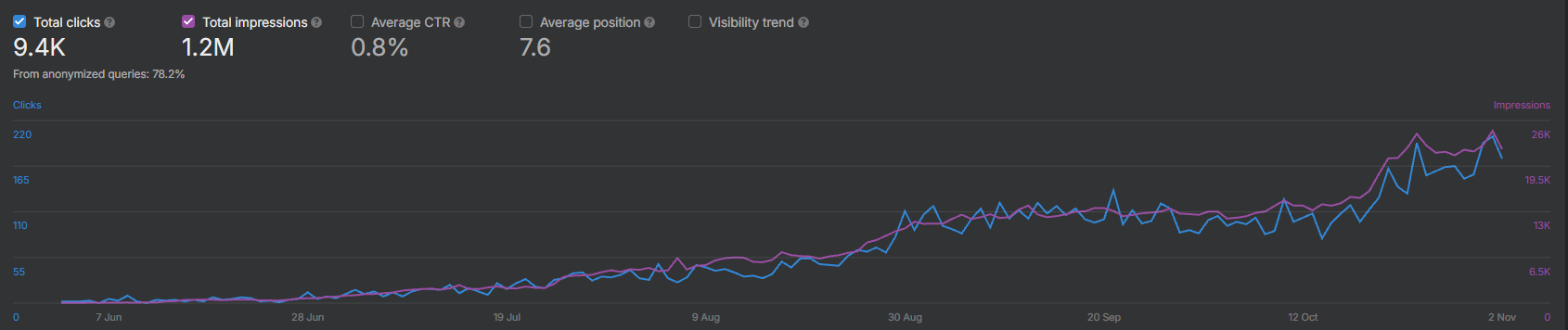
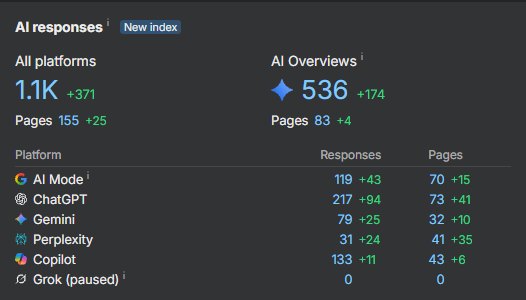
By 6 November 2026, Ahrefs counted 1,115 AI answers citing the site, 536 of them in Google AI Overviews.
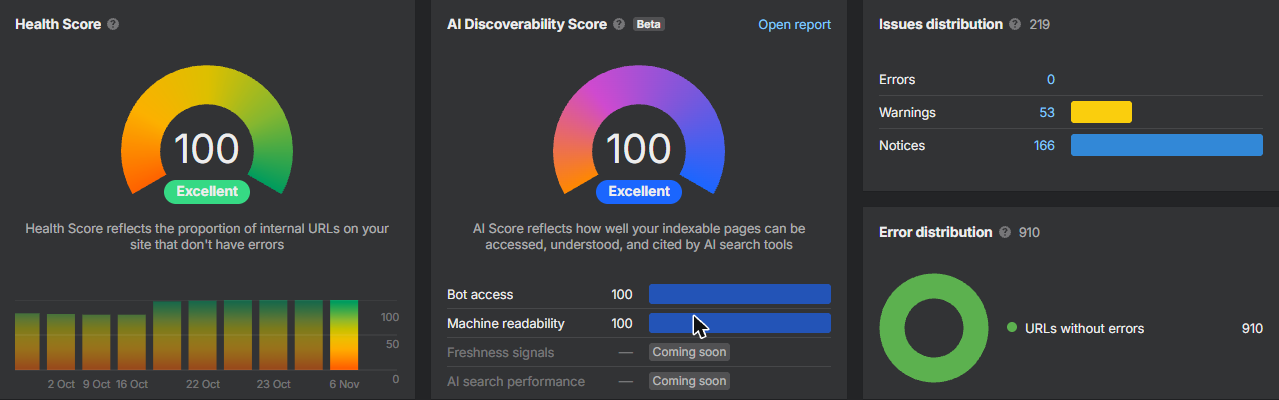
You can read the full case study with sources and screenshots.
The takeaway
AI makes SEO faster. It doesn’t make it right. Use it for volume, keep people on the decisions that affect customers, and write the checks down so they happen every time.
If you’d like this workflow applied to your site, see how SEO strategy and content management works or compare the monthly plans.
FAQs
1. Does Google penalise AI-written content?
Google’s guidance focuses on whether content is helpful and accurate, not on how it was produced. Unedited, inaccurate content is the risk, which is why every draft is checked and edited.
2. Which AI tools do you use?
Claude and ChatGPT for research, briefs and drafts, and Higgsfield for graphics. Ahrefs, Google Search Console, Google Analytics and Google Keyword Planner supply the data.
3. How much time does AI save?
The biggest savings are in research and first drafts. That time goes back into editing, fact-checking and strategy, which is where quality comes from.