
Digital PR for small brands means creating stories, data and expert comment that journalists, bloggers and newsletter writers want to cover, so the coverage links back to your site. You don't need an agency or a big budget. You need a genuinely interesting angle and a short list of the right writers.
I'll give you 12 ideas sized for small teams, show you how to turn your own data into a credible story, and explain how to find and pitch the right people.
You'll also get pitch and follow-up templates, the Google rules that apply to PR links, and a simple way to measure what coverage actually does for you.
Key takeaways
- Link building outreach earns links by being useful. Digital PR earns them by being newsworthy. Most small brands need both.
- Your own data, your expertise and your local community are angles big brands can't copy.
- Host every story on a page on your own site, with the figures and method, so writers have something to link to.
- Pitch fewer, better-matched writers. Fit with their beat matters more than the size of the outlet.
- Google's spam policies cover PR too: no optimised anchors in press releases, and gifted products in return for links need qualifying.
What digital PR is, and how it differs from link building

Link building outreach asks a site to add a link to a page that already exists. Digital PR gives a writer a reason to create something new in which you are the source. Both are ways to earn links without buying them, but they suit different situations.
| Approach | What you offer | Typical result | Best for |
|---|---|---|---|
| Link building outreach | A useful page, a fix for a broken link, a reminder about a mention | A link added to an existing page | Steady, niche-relevant links |
| Digital PR | A story, original data or expert comment | New coverage with a link or a named mention | Bursts of authority and brand awareness |
| Traditional PR | Announcements, interviews, events | Coverage, often without links | Reputation and reach |
Coverage doesn't always include a link. A named mention still drives brand searches and gives AI tools another source connecting your name with your topic, so I count both and chase links only where it makes sense.
Why small brands have an advantage
Small brands often assume digital PR belongs to big companies with agencies. In practice, small businesses have strengths that make them good sources:
- Access. A founder can talk to a journalist today. Large brands often need approvals before anyone can comment.
- Depth. You know one subject very well, and you see what your customers actually do.
- Local relevance. Regional media, community sites and local newsletters need local sources.
- Real stories. A small business's wins and struggles are relatable in a way corporate announcements rarely are.
- Speed. You can respond to a news story within the hour, while it still matters.
Every business has a different mix of these strengths, so build your first campaign around the one you have most of.
12 digital PR ideas that suit small budgets

The examples below are illustrations, not client results. Swap in your own industry and data.
Data-led ideas
- Trends from your own sales or enquiries. An online butcher could publish which cuts sell most each winter by state. A plumber could share the most common call-out problems by month. Anonymise everything.
- A recurring price or cost tracker. Track what a typical basket of items in your niche costs each quarter. Repeating it gives writers a reason to come back, and each update is a fresh story.
- A small, honest customer survey. Ask your customers five sharp questions and report the sample size clearly. A survey of 300 customers is a perfectly good story if you call it that.
- Public data, re-cut for your niche. Government sources such as the Australian Bureau of Statistics' published data are free to analyse. Pull out what matters to your audience and explain it plainly, crediting the source.
Expert-led ideas
- Reactive comment. When news breaks in your industry, send a short, quotable take to writers covering it, the same day.
- Journalist request services. In Australia, SourceBottle emails journalists' call-outs for sources to subscribers. Internationally, Featured.com acquired HARO in April 2025 and kept it free for journalists and sources. Qwoted is another option.
- Myth-busting. List the most common misconceptions in your field and correct each one with evidence. Writers love a clear "actually, here's how it works" angle.
- Seasonal expert Q&A. Offer ready-made answers to the questions people ask before holidays, weather changes or industry events, sent four to six weeks ahead.
Community and local ideas
- Local milestones and partnerships. Anniversaries, new premises, hiring local apprentices or working with a local charity are real stories for regional media.
- A local resource only you could make. A map of farmers' markets, a guide to dog-friendly venues, or seasonal opening hours across your area. These earn links from councils, clubs and local blogs, and fit neatly into the first 30 days of local SEO.
Asset-led ideas
- A free tool or calculator. A cost, quantity or savings calculator gives writers something to reference whenever the topic comes up.
- A visual explainer. A clear chart, map or diagram that explains something confusing in your field. Offer it free to use with a credit.
How to build a data story without overstating it

Credible data gets reused for years. Exaggerated claims get ignored, corrected, or quietly removed. This is the process I follow:
- Start with a question a reader would ask, such as "Are people buying more lamb this winter?", not "How do I get links?"
- Pull the data and record its limits: date range, sample size, regions and anything excluded.
- Find the one headline finding and make it the first line of everything you send.
- Test it against a sceptical editor. If the sample is small or the period is short, describe the finding as indicative.
- Publish it on your site first, with the method, before you pitch anyone.
Here is the difference honest framing makes, using a hypothetical retailer:
- Overstated: "Australians are ditching beef for lamb."
- Honest: "Lamb orders at [Business] rose [X]% this winter compared with last winter, across [n] orders in [states]."
The honest version is still a story, and a journalist can publish it without worrying about a correction. Add a methodology block like this to the landing page:
About this data
Source: [Business] order data, [start date] to [end date]
Sample: [n] orders from [n] customers in [regions]
What was measured: [e.g. share of orders containing lamb, by month]
Limitations: [e.g. online orders only; not representative of all
Australian shoppers]
Media contact: [Name], [email], [phone]
Make your landing page the thing they link to
Writers link to sources that make their job easier. If your story only exists in an email, there is nothing to link to. Build one page per campaign that includes:
- The headline finding in the first paragraph, written as a plain sentence a journalist could quote.
- Charts saved as images with descriptive alt text and a credit line.
- The methodology block and any important caveats.
- A short quotable comment from a named person, with their role.
- A media contact and, where it makes sense, the underlying figures as a downloadable CSV.
Pages like this are also the kind of clear, sourced content AI answers draw on. Once a campaign is live, tracking AI mentions of your brand shows whether it is being cited beyond the original coverage.
How to find the right journalists and writers
Most pitches fail because they go to the wrong person. In my experience, a list of 20 well-matched writers beats 500 scraped addresses.
- Search Google News for your topic and note who wrote the recent pieces.
- Read their last five articles. Do they cover this subject regularly? Do they link to sources?
- Look beyond newspapers. Trade publications, email newsletters, podcasts and niche blogs often link more readily and reach more relevant readers.
- Add local media for any story with a local angle, including community news sites and council newsletters.
- Subscribe to journalist request services and filter call-outs to your area of expertise.
- Record why each person fits: one line per writer naming a recent article that matches your story.
That last column is what makes your pitch personal. If you can't fill it in, that writer is not on the list.
How to write a pitch that gets read

A pitch has one job: to make the writer want to open your page. These are my rules:
- Put the finding in the subject line, not your company name.
- Open with why it matters to their readers.
- Give three short facts, then the link to the full data.
- Offer a comment or extra cut of the data for their region or angle.
- Keep it under about 150 words, with no attachments.
- Send one follow-up after five to seven working days, then stop.
Template: data story pitch
Subject: [Headline finding, e.g. "Lamb orders up X% this winter in Victoria"]

Hi [First name],

I saw your piece on [recent article] and thought this might be
useful for a follow-up.

[Business] analysed [n] orders from [date range]. Three findings:
- [Finding 1, with figure]
- [Finding 2, with figure]
- [Finding 3, with figure]

Full data, charts and method: [https://yourdomain.com/campaign-page]

I can share a breakdown for [their region/angle] or a comment from
[Name, role] if helpful.

[Your name]
[Role], [Business] | [Phone]
Template: reactive expert comment
Subject: Comment on [news story] from a [your role]

Hi [First name],

On today's [news story]: here's a comment you're welcome to use,
attributed to [Name], [role] at [Business].

"[Two or three sentences. Specific, opinionated, plain English.]"

Background on [Name]: [one line on relevant experience].
Happy to expand by phone today: [phone].

[Your name]
Template: local story
Subject: [Town] business [milestone, e.g. "takes on its fifth local apprentice"]

Hi [First name],

[Business] in [suburb] has [milestone], which [why it matters
locally, e.g. "means five local school leavers have trained at
[Business] since [year]"].

[Name] is available for an interview, and I can send photos.
More details: [https://yourdomain.com/news-page]

[Your name] | [Phone]
Template: one follow-up
Subject: Re: [original subject]

Hi [First name],

Following up once in case this is useful. One extra point that
didn't make the first email: [new, specific detail].

Full data: [URL]. No need to reply if it's not a fit.

[Your name]
Template: asking for a link after coverage
If a piece uses your data without linking to the source, a polite request is reasonable. If it only mentions you in passing, let it be.
Subject: Thanks for the coverage

Hi [First name],

Thanks for including [Business]'s [data/comment] in [article title].

If it's useful for readers who want the full breakdown, the
source page with the method and charts is here: [URL].
Completely understand if your style is not to link.

[Your name]
Staying inside Google's rules
Google's spam policies apply to PR links like any others. They list links with optimised anchor text in press releases distributed on other sites as link spam, along with sending someone a product in exchange for writing about it and including a link. Keyword-rich or hidden links in widely distributed widgets are on the same list.
- Press release distribution is fine for reach, but keep any links to your brand name or the plain URL, and expect them to be nofollow.
- Gifting products is fine. If coverage with a link is part of the deal, the link should be marked rel="sponsored", and the writer should disclose it.
- Paid features and advertorials are advertising, so their links should be sponsored too.
- Embed codes for charts or tools should credit your brand name and let publishers edit or remove the link.
- Never pay a contributor at a publication to slip your link into an article.
Staying inside these rules costs you nothing that matters. The links that move rankings and send readers are the editorial ones you earned with a good story.
How to measure digital PR
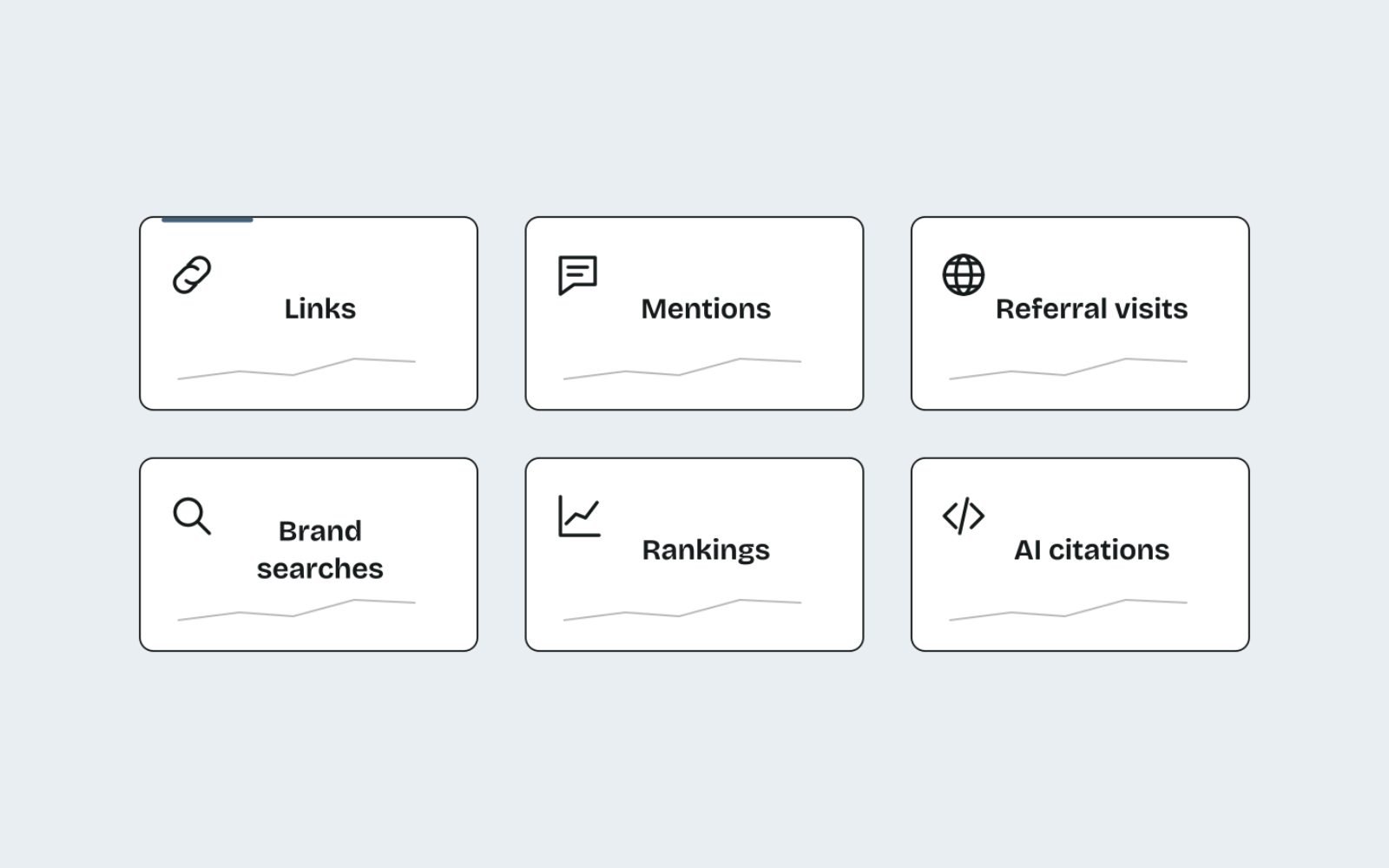
Judge each campaign on what it did for your site and your brand, not on a count of articles. I track these:
| Metric | Where to check | What it tells you |
|---|---|---|
| Linked coverage | New referring domains in Ahrefs or Semrush | Authority the campaign earned |
| Unlinked mentions | Google Alerts for your brand and campaign name | Reach, plus pages worth a polite link request |
| Referral traffic | GA4: Reports, Acquisition, Traffic acquisition, by Session source / medium | Whether real readers clicked through |
| Branded search | Search Console Performance, filtered to queries containing your brand | Whether more people now look you up |
| Landing page performance | Search Console Performance with a Page filter | Rankings and clicks for the campaign page itself |
| AI citations | Ahrefs AI responses or manual checks in AI tools | Whether AI answers now cite you on the topic |
Citations are worth tracking separately from links. In the Pups4Sale results, 814 AI answers cite the site (Ahrefs AI responses, 6 Nov 2026), 392 of them from Google AI Overviews, and that is a number a link count would never show.
Give each campaign a few months before judging it, and compare it against the cost in your own time. Some campaigns earn nothing; the ones that land often keep earning links for years.
The bottom line
Give writers something worth citing: honest data, sharp expert comment or a genuine local story, hosted on a page that makes linking easy.
Run digital PR alongside quieter tactics such as replacing dead links, so you earn links steadily between campaigns.
Every brand has its own story to tell, and the same citable content that earns coverage also feeds AI search visibility. If you want help finding your angle, send me a few details about your brand.
FAQs
1. What is the difference between digital PR and link building?
Link building outreach asks sites to add a link to an existing page, for example to replace a broken link. Digital PR creates a story, data or comment that writers cover in new articles. Both earn editorial links; digital PR also builds brand awareness.
2. Do I need a PR agency for digital PR?
Not to start. A strong angle, an honest landing page and a short list of well-matched writers go a long way. An agency makes more sense once you have proven which angles work and want to run campaigns more often.
3. How much does digital PR cost for a small business?
The main cost is time: analysing data, writing the landing page, building a writer list and pitching. Tools such as Ahrefs or Semrush help with measurement, but free tools like Google Alerts and Search Console cover the basics.
4. What if coverage doesn't include a link?
A named mention still builds brand searches and helps AI tools connect your brand with the topic. If the article uses your data, you can politely share the source page once. If it is a passing mention, let it go.
5. Are press releases good for SEO?
Press releases can earn coverage when they carry real news, but the release links themselves do little. Google's spam policies list optimised anchor text in distributed press releases as link spam, so keep links to your brand name or URL.
6. How long does digital PR take to work?
Coverage can arrive within days of a pitch, but the effect on rankings depends on the links earned and your competition. I review campaigns over several months and never treat any single campaign as a guaranteed result.